Facilities Overview
In CygNet, the term "facility" is used to represent a logical (or abstract) grouping of data, real or defined. A facility can represent an RTU, a flow computer, a meter, or a tank battery. It can represent a manufacturing line, a building, or a specific process. It can represent a process or a collection of points that are not device-oriented, such as a set of scripted points or OPCIS points. The definition and grouping for a facility makes sense for a given usage purpose.
A remote device (RTU, PLC) is a facility. It is a logical grouping of data: battery voltage, battery temperature, firmware version, operational status, etc. A flow computer is a facility. Its group of data includes flow rate, flow temperature, differential and static pressures, and volumes.
Facilities are a critical element of CygNet. In addition to logically grouping data, they are used to define the relationship between points and hardware I/O. They ease the sorting and filtering of data, and allow many facets of the system to be templated, including human-machine interface (HMI) screens, graphs, and reports.
Examples of logical groupings are:
- A remote device (status, battery voltage, firmware version).
- A subgroup within a remote device such as flow computer, well, meter, and tank battery (pressures, rates, temperatures, valve positions).
- A gas plant.
- A compressor station.
- A communication device (communication statistics).
- An import device (import statistics).
- Non-device point tags may represent logical groupings, such as a collection of scripted point tags, OPC Interface Service point tags, or Service Monitoring Service point tags.
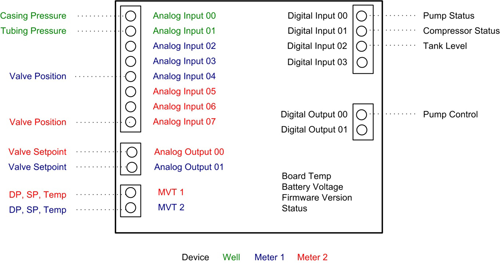
The drawing below shows an example of facilities on a single remote terminal unit (RTU). The elements shown in green represent a well. The elements shown in red and blue represent meters. The elements shown in black represent RTU elements or are not specific to any one facility.
|
Facilities on Single RTU |
See CxEditors CxFacEditor Object for more information about scripting the FAC Editor.
More:
 Device Facilities and Linked Facilities
Reference Facilities and Relative Facilities


